
How Do the Springs on a Reformer Pilates Machine Actually Work?

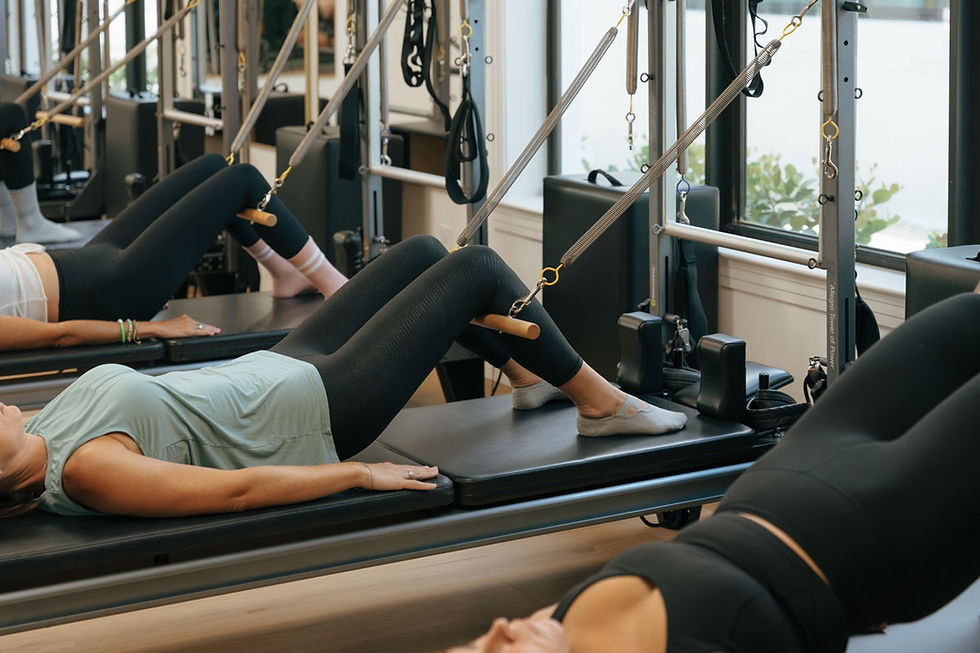
Short Answer: They Create Adjustable Resistance That Challenges and Supports Movement.
The springs on a reformer don't simply add weight. They create adjustable tension that can make an exercise more challenging or more supportive, depending on the movement. They also help control the carriage, improve body awareness, and encourage smooth, precise movement.
If you've never used a reformer before, the springs are usually the first thing that catches your eye. Thick metal coils stretch and contract as the carriage moves, and instructors seem to change them throughout class. It's easy to assume they're there for the same reason you'd add plates to a barbell.
They're actually doing something much more interesting.
The springs are what make reformer Pilates feel different from almost any other workout. They resist your movement while also guiding it, helping you build strength, improve control, and move more efficiently.
The Springs Create Tension, Not Weight
Unlike lifting a dumbbell, where gravity provides constant resistance, reformer springs work through tension.
As you push or pull the carriage, the springs stretch. The farther they stretch, the more resistance they create. That means your muscles stay engaged throughout the movement instead of working hardest at only one point.
Because the resistance changes throughout the movement, you're encouraged to stay in control instead of relying on momentum. The carriage responds immediately to how you move, rewarding smooth, steady control and making rushed movements much more noticeable.
More Springs Can Actually Make an Exercise Easier
This surprises almost everyone during their first class.
Adding more springs doesn't always make an exercise harder. In some cases, extra spring tension actually provides more support.
For example, when you're lying on your back during footwork, heavier springs create a stable platform to press against. During exercises where you're standing, kneeling, or balancing on the carriage, lighter springs often require much more control because the carriage moves more freely beneath you.
That's why the spring settings change throughout class. Your instructor will cue everyone when it's time to add or remove a spring so the resistance matches the next exercise.
Why the Springs Change Throughout Class
Every exercise has a different goal, and the spring tension helps match that goal.
If the focus is building leg strength, heavier springs may be the right choice. If the objective is improving balance, coordination, or core stability, lighter springs often create a more appropriate challenge.
Your instructor also considers your experience, strength, mobility, and the way you're moving that day. Two people performing the same exercise may use different spring combinations and both receive exactly the challenge they need.
At Living Well Pilates in Palm City, your instructor will cue the class when it's time to add or remove a spring. If a different setting would better suit your strength, mobility, or experience level, they'll let you know. If you're curious about what your first visit looks like, our reformer Pilates classes explain what to expect.
The Springs Help You Learn Better Movement
The springs do more than create resistance. They also provide immediate feedback about how you're moving.
If one side of your body pushes harder than the other, if your core loses engagement, or if you rush through an exercise, you'll often feel it through the carriage almost instantly.
That feedback helps you make small corrections as you move instead of waiting for someone to point them out. As your coordination improves, those movement patterns often carry into everyday activities like climbing stairs, lifting groceries, or simply standing taller.
If you'd like even more individualized instruction before joining group classes, private Pilates sessions offer one-on-one coaching tailored to your goals and experience.
Do Beginners Need to Understand the Springs?
Not at all. Choosing the right spring setting is part of your instructor's job. Your job is simply to move with control, pay attention to the coaching, and enjoy learning something new.
As you gain experience, you'll naturally begin to recognize how different spring combinations feel and why they're used. Before long, changing springs becomes just another part of your workout.
If you're thinking about trying reformer Pilates for the first time, don't worry about learning the mechanics before you walk through the door. Your instructor will handle every adjustment so you can focus on moving well and building confidence. When you're ready, you can explore the current class schedule.


Comments