
Pilates for Women Over 50 in Palm City and Stuart

The short answer: Pilates is one of the best ways for women over 50 to stay strong, steady and mobile. Reformer Pilates builds muscle with adjustable spring resistance, trains balance and posture, and is gentle on the joints. That matters after 50, when muscle, bone and balance all start to change. You don't need to be fit or flexible to start. Your instructor sets the springs and options for your body.
Key takeaways
After menopause, bone loss speeds up, and it is fastest in the first few years.
Public health guidelines call for muscle-strengthening activity at least 2 days a week, plus balance training as we age.
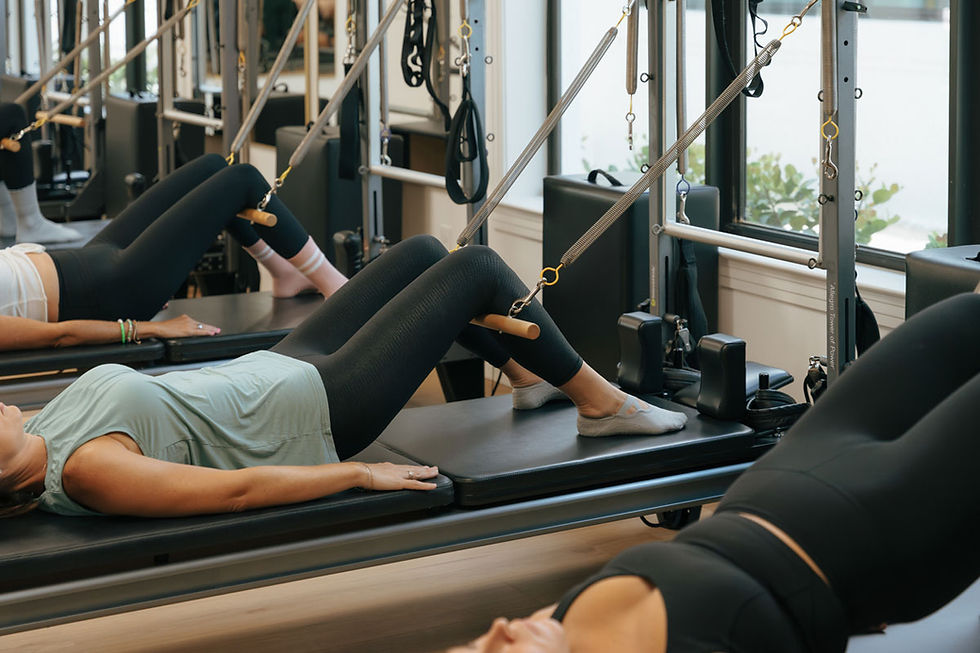
Reformer Pilates combines strength, balance and mobility in one low-impact session.
Every exercise can be modified, so it works whether you're 50, 65 or 80.
Two to three classes a week is a great goal. One a week is a great start.
What changes for women after 50?
Midlife brings real changes, and knowing what they are makes it easier to train for them.
Bone. Estrogen helps build and maintain bone. According to the National Institutes of Health, bone loss speeds up after menopause, is most rapid in the first few years, and continues into the postmenopausal years. The U.S. Office on Women's Health notes that some women lose up to 25% of their bone mass in the first 10 years after menopause.
Muscle. Strength naturally declines with age unless we work to keep it. Strong muscles make daily life easier, from carrying groceries to getting up off the floor.
Balance. Balance and reaction time can slip without practice, which is why public health guidelines recommend balance training for older adults.
Posture and stiffness. Years of sitting, driving and looking at screens can leave the upper back rounded and the hips tight.
The good news: all four respond to training.
How much exercise do women over 50 need?
The Physical Activity Guidelines for Americans recommend that adults do muscle-strengthening activities on 2 or more days a week, and that older adults do multicomponent activity that includes balance training along with aerobic and strength work. The CDC says adults 65 and older need at least 2 days a week of muscle-strengthening activity plus activities to improve balance.
Reformer Pilates checks the strength and balance boxes in a single session. Pair it with walking, swimming, cycling or pickleball for the aerobic part.
Why reformer Pilates works so well after 50
Real strength, adjustable resistance. The reformer's springs let you build strength in your legs, hips, back, arms and core. Your instructor can add or remove springs so you're challenged without overdoing it.
Low impact, kind to joints. There's no jumping or pounding. Many exercises are done lying down or seated, which supports the body while you build strength. See low impact Pilates for joint pain.
Balance and control. Slow, precise movements train the stabilizing muscles and coordination that keep you steady on your feet.
Posture. Pilates strengthens the muscles along the spine and opens the chest and hips. More in how reformer Pilates improves posture.
Core and pelvic floor. Pilates trains the deep core and pelvic floor, which support the spine and everyday movement. Read does Pilates strengthen the pelvic floor?
Pilates through menopause and beyond
Many women start Pilates during perimenopause or menopause, looking for a workout that builds strength without wearing them down. Pilates can help you:
Keep and build muscle with steady, progressive resistance
Stay mobile through the hips, spine and shoulders
Improve balance and body awareness
Make time to slow down and breathe, which many women value as much as the physical work
Is Pilates good for bone health?
Strength training is a key part of bone health, and the reformer lets you load your muscles in a controlled way. If you've been told you have low bone density, osteopenia or osteoporosis, let your instructor know before class. Pilates can be adapted. For example, your instructor can swap out exercises that involve deep forward rounding of the spine for ones that keep the spine long and supported, while still building strength in the legs, hips and back.
Can I start Pilates at 60, 70 or older?
Yes. It is never too late to build strength and balance. Start where you are. If you have an old injury, a joint replacement, or you simply want to learn the equipment before joining a class, start with a private session. Our private reformer sessions are designed for clients who are new to the reformer, returning after injury, or working with physical limitations.
What is a first class like?
You'll be welcomed, shown how to set up your reformer, and guided through every exercise. Your instructor will offer options so you can work at the right level. Here's what to bring:
Grip socks (required, and sold in the studio)
Comfortable, fitted clothing so your instructor can see your alignment
Water, kept on the floor away from the machines
Please tell your instructor about any injury, surgery or condition before class. It helps us set you up well. For more, read what to expect in your first reformer Pilates class.
How often should women over 50 do Pilates?
Two to three classes a week is a great goal for building strength and balance. One class a week still helps, especially if you're also walking, swimming or playing pickleball. Consistency over months is what pays off. Read how many days a week should you do Pilates?
Our memberships are built around that rhythm: Rooted Rhythm (4 classes a month, $120), Living Steady (8 classes a month, $190), and Live Fully (unlimited, $274 a month). Drop-ins are $34. See all options on our pricing page.
Here for the season?
Plenty of Treasure Coast residents split the year between Florida and somewhere up north. Drop-ins at $34 and our New Client Intro are easy ways to practice while you're here.
Frequently asked questions
Is Pilates good for women over 50?
Yes. Pilates builds strength, balance, mobility and posture with low impact, which is exactly what most women want after 50.
Is reformer Pilates safe for seniors?
Reformer Pilates is low impact and can be adjusted for any level. Tell your instructor about any injuries or conditions so they can set you up with the right options.
Can Pilates help with bone density?
Strength training supports bone health, and reformer Pilates is a form of strength training. If you have low bone density, let your instructor know so they can adapt exercises for you.
How long until I notice a difference?
Many people feel more aware of their posture and core within a few classes. Changes in strength and balance build over a few months of consistent practice. See Pilates 30-day before and after.
Do I need to be flexible to start?
No. Flexibility is a result of Pilates, not a requirement.
Should I start with a group class or a private session?
Either works. Private sessions are a good choice if you have an injury or want to learn the equipment one-on-one first.
Start where you are
Begin with our New Client Intro: 3 classes for $75, used within two weeks of your first class. Book in the Living Well Pilates app or on our schedule, or call (772) 210-4712. We're at 3377 SW Mapp Rd in Palm City, an easy drive from Stuart, Jensen Beach, Port St. Lucie and Hobe Sound.


Comments